 |
 This pair of figures from the southern coastal region of Ghana, near Prampram, belongs to the cultural context of the Ga-Adangbe groups, whose sculptural practice is closely linked to ancestor worship, protective functions, and local ritual systems. Such paired figures can be understood as complementary units that visually articulate social dualities - such as gender, kinship, or spiritual balance. Formally, the figures are characterized by radical reduction and a clear, almost geometric body language. The spherical heads with hole-like eyes, simple openings for ears, and slightly open mouths create a compelling, de-individualized presence. The elongated noses appear as linear protrusions that emphasize the verticality of the composition. This verticality continues in the long necks and torsos, while the arms and legs are strongly foreshortened and tapered to points, without elaborate limbs. Nipples and navels are marked as simple perforations and integrate into the reduced formal language. The surfaces are speckled with red and white pigments, indicating ritual treatment and symbolic significance. Distinct cracks, chips, and signs of wear attest to their long history of use and point to the figures' integration into repeated cultic practices. Their ascetic form and material density manifest an aesthetic that focuses less on mimetic representation than on the concentration of presence and power. Literature (selection) CAB 46915 sold Height: 50 cm / 55 cm |
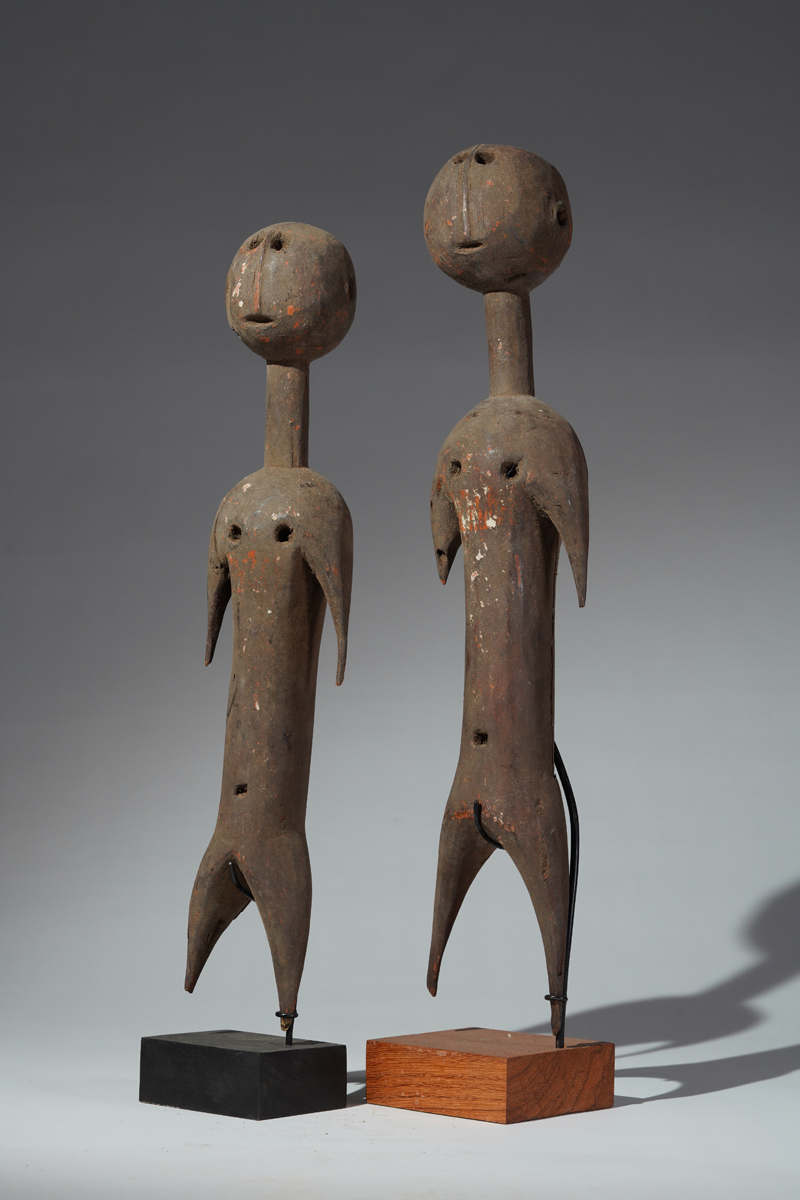 photo: wolfgang-jaenicke.com, for more information, please write us an e-mail with the identification number of the photo identification no. CAB46915.jpg |
 |