 |
 This iron sculpture from northern Togo belongs to the cultural context of the Moba (Bimoba) people, whose material tradition is characterized by a reduced, highly abstracted formal language. Metal objects of this kind are often associated with protective, ancestral, or amuletic functions and are to be understood less as mimetic representations than as condensed carriers of spiritual presence. The figure exhibits a consistently vertical, rod-like structure in which the head and body merge almost indistinguishably. Only a slight increase in volume marks the head area and provides a minimal accent within the otherwise strict linearity. A fine rope wrapping in the upper part of the head suggests ritual activation or binding and can be interpreted as an indication of the object's integration into cultic practices. The body tapers slightly downwards and ends in a pointed base, which, together with the plinth, creates stability and simultaneously a certain dematerialization of the form. Small protrusions distributed across the surface interrupt the smooth reduction and lend the figure a subtle rhythmic structure, possibly reflecting symbolic markings or traces of the manufacturing process. In its radical simplification and material-focused presence, the sculpture articulates an aesthetic of condensation, in which iron functions not as a medium of representation but as a vehicle for invisible forces and relational meanings. Literature (selection) Roy, Christopher D.: Art of the Upper Volta Rivers. Paris, 1987. CAB 47057 sold Height: 78 cm |
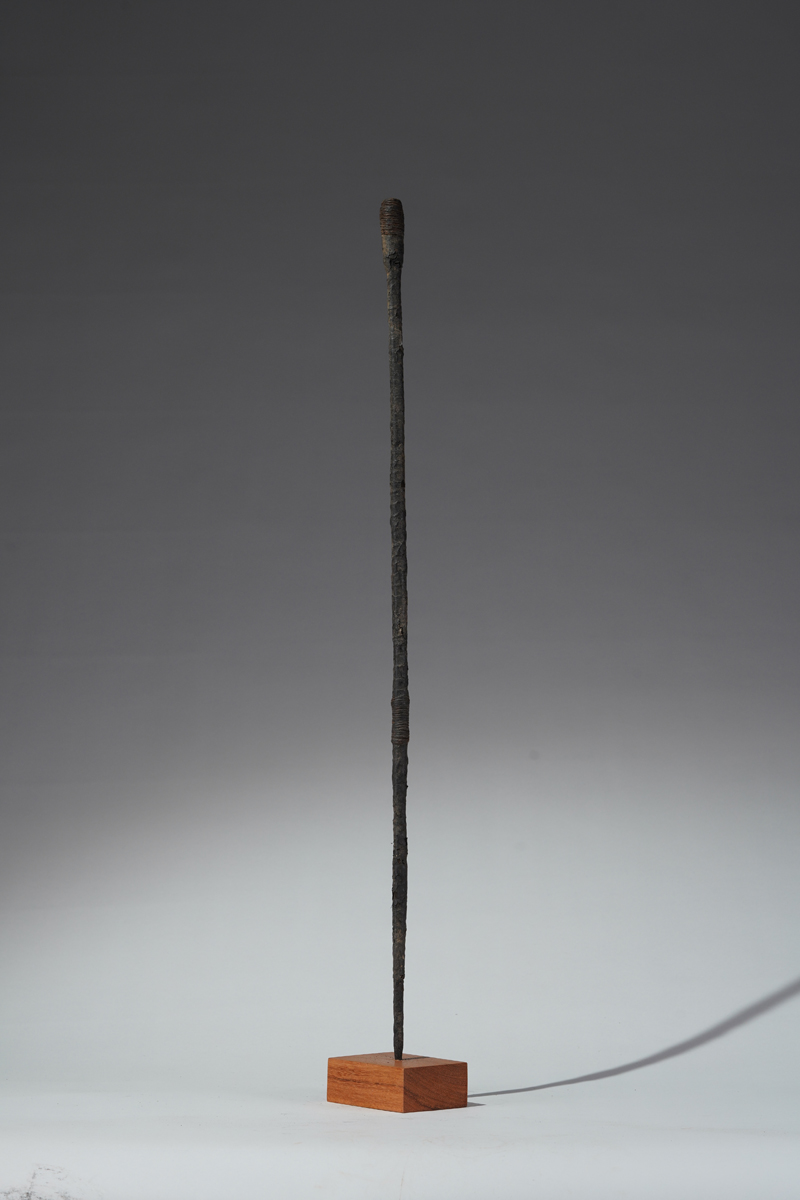 photo: wolfgang-jaenicke.com, for more information, please write us an e-mail with the identification number of the photo identification no. CAB47057.jpg |
 |