 |
 This wooden sculpture from Taraba State in eastern Nigeria belongs to the cultural context of the Mumuye people, whose figurative traditions are among the most distinctive forms of abstract representational art in West Africa. Mumuye figures (iagalagana) are not primarily naturalistic depictions, but rather visual constructions of spiritual presence used in ritual, divinatory, and protective contexts. The figure exhibits a strictly vertically organized composition in which the head, torso, and limbs are in a dynamic relationship to one another. The helmet-like headdress with its comb-like top forms a striking visual focal point and suggests a higher, possibly spiritually charged, authority. Directly below it, a pointed beak emerges, while the circularly carved eyes are positioned on the underside of the helmet, lending the figure an appearance that is both watchful and ethereal. The long neck is structured by cord-like muscle groups, conveying heightened physical tension. In contrast, the arms are short and simply rendered, with reduced hands, which emphasizes the vertical axis. The torso is accentuated by a pronounced chest and a clearly defined navel, while the short legs with suggested knees transition into simple feet. The glossy patina and cracks in the helmet and body surface suggest age and ritual use. In its formal condensation, the figure articulates an aesthetic of presence, in which physicality appears as a vehicle for spiritual efficacy. Literature (selection) Fagg, William: Nigerian Images. London, 1963. CAB 47113 sold Height: 95 cm |
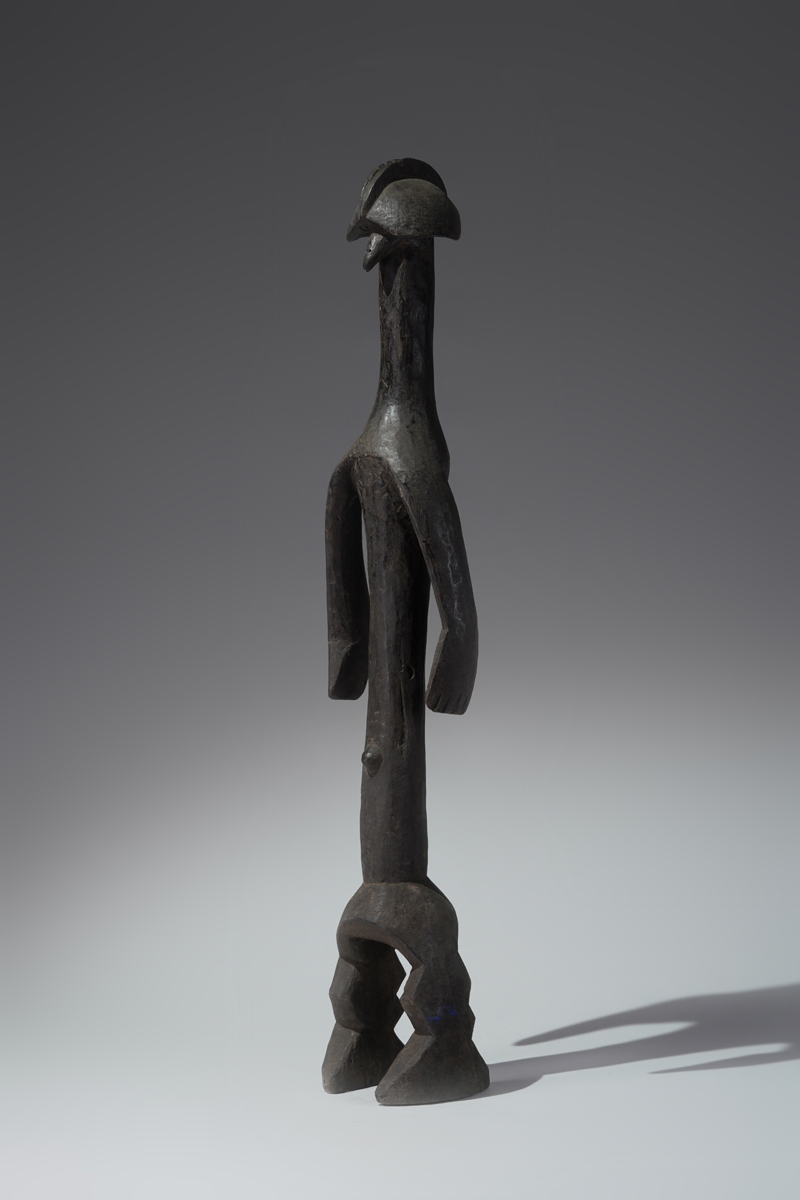 photo: wolfgang-jaenicke.com, for more information, please write us an e-mail with the identification number of the photo identification no. CAB47113.jpg |
 |