 |
 The present head sculpture from the Tillabéri region in western Niger is situated within the cultural and archaeological context of the Bura culture, whose material remains are among the key testimonies of pre-modern societies in the middle Niger Bend. The Bura tradition, primarily known for its ceramic and stone sculptures, is often associated with funerary practices, ancestor worship, and the visual marking of social continuity. The sculpture depicts an oval head, tilted slightly backward, resting on a neck that transitions into a fragmentarily preserved bust form. This deliberate reduction of the body to the head suggests a concentration of symbolic meaning in the realm of identity and memory. The face is structured by a systematic groove pattern: two parallel lines run vertically from the top of the head to the forehead, while further grooves divide the two halves of the face, creating a rhythmic, almost textural order. The facial features are highly abstracted, yet clearly legible: slit-like, half-closed eyes, a straight, reduced nose, and a slightly open mouth form a reserved, contemplative physiognomy. The simply crafted ears blend into the overall austere formal language. A crack in the upper lip is particularly noteworthy, as it, along with other chips and signs of age, suggests a long history of use and possibly ritual significance. In its formal simplicity and structural clarity, the sculpture embodies an early Sahelian pictorial tradition in which the human head is understood as a bearer of memory, presence, and transgenerational meaning. Literature (selection) Gronenborn, Detlef: Archaeology of the Bura Culture. Frankfurt, 1999. CAB 47183 sold Height: 19 cm |
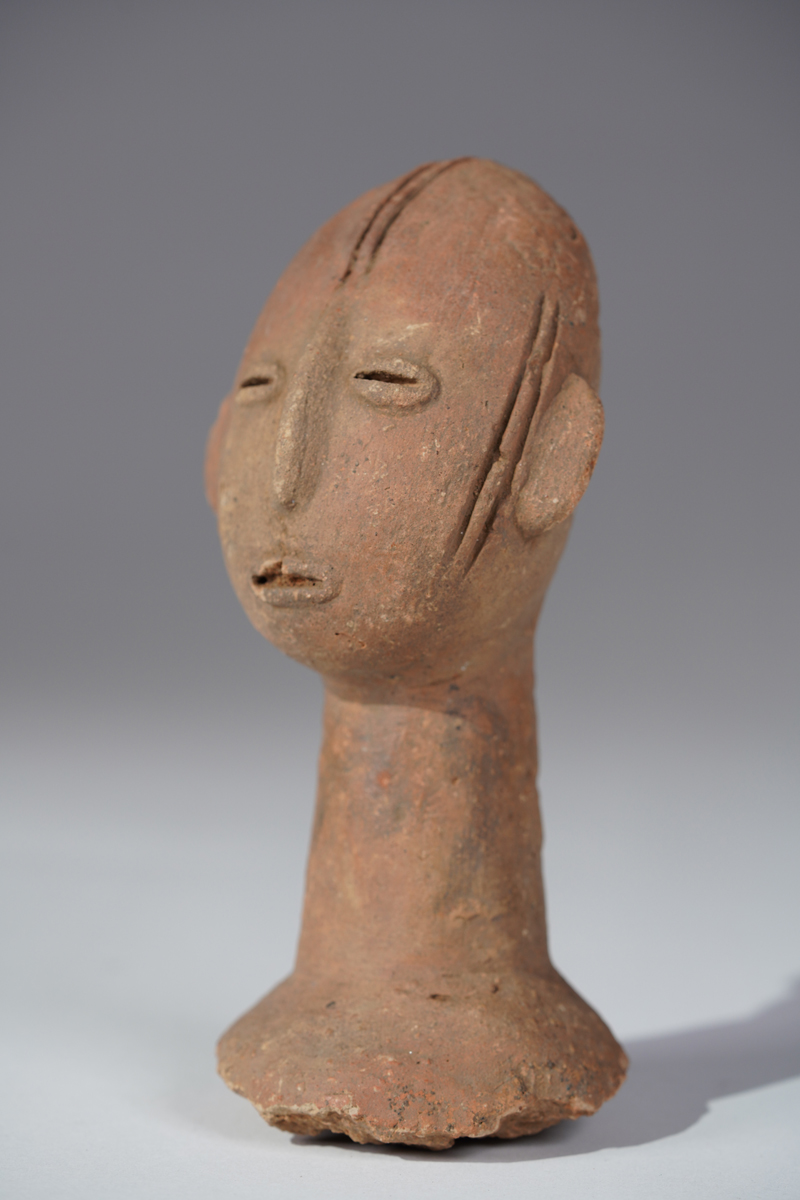 photo: wolfgang-jaenicke.com, for more information, please write us an e-mail with the identification number of the photo identification no. CAB47183.jpg |
 |